

I’ve been at Useberry for four years now. Long enough for my relationship with certainty to change.
As a marketer, I’ve been obsessed with people. Why they click. Why they hesitate. Why something feels obvious to one person and invisible to another. That curiosity shaped how I approached messaging, positioning, and growth long before I ever thought in terms of UX.
But being inside a company that lives and breathes user research does something to you. You start seeing behavior differently. You start questioning your own assumptions in real time.
A lot of that came from working closely with Harry Karanatsios, our Senior UX Researcher. He has an almost unusual ability for unpacking human behavior and a talent for asking questions that quietly dismantle assumptions. Over time, those conversations rewired how I evaluate products, decisions, and even my own confidence.
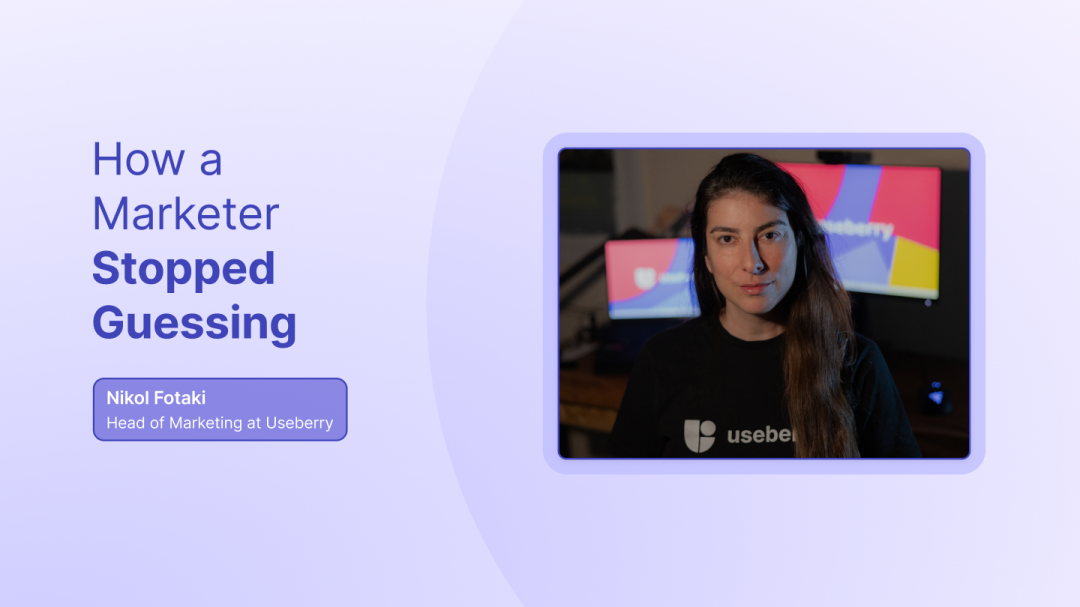
Hi, I’m Nikol, and I lead the marketing team here at Useberry. This is the story of how I moved from trusting my gut to truly understanding users.
But the story starts long before Useberry. Back when instinct still felt like enough.
When I Was Building Without a Map
Eight years ago, in 2018, I built my own jewelry e-shop, Icebow Designs. One product category. Rings.
Simple on the surface. Complicated the moment real people got involved.
Buying rings online comes with friction baked in. People rarely know their finger size. I didn’t have the language for it back then, but I was staring straight at a user experience problem.
What I did know was this: if customers got the wrong size, they’d be disappointed.
So I did what made sense at the time. I talked. I brainstormed. I assumed.
Together with the design agency building the site, we tried to solve the problem by making things clearer and simpler.
There were already solutions out there. Printable guides. Paper templates. Measure-this-at-home flows.
But they felt heavy. Unrealistic. A lot of effort for someone who just wanted to buy something nice.
So we asked ourselves a very familiar question:
What’s the easiest possible way?
When “It Works for Us” Felt Convincing
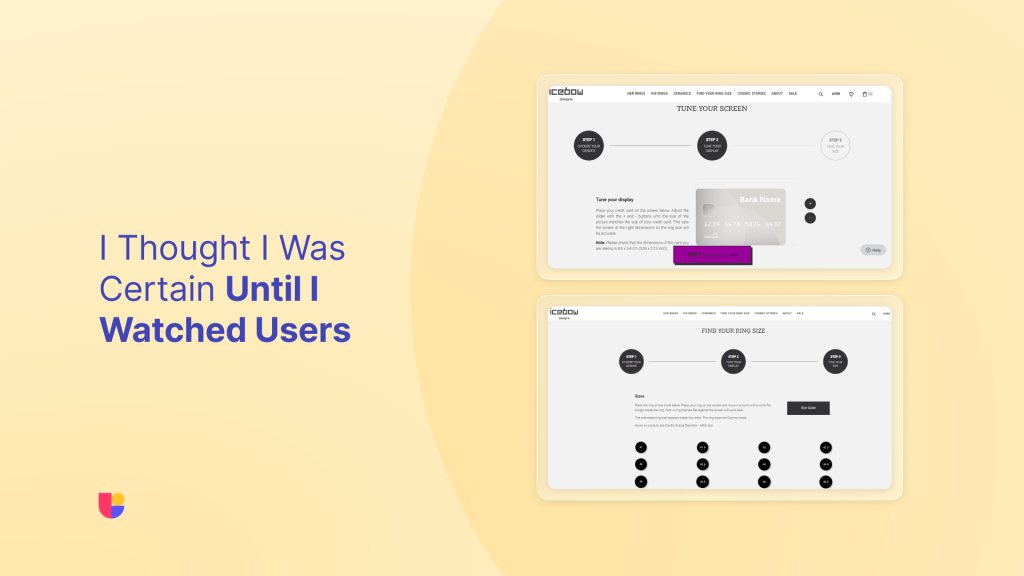
We landed on a web app that used objects people already had. A ring. A credit card. Something tangible, something familiar.
We built it. It functioned. It looked fine.
Then came testing. Or what we called testing.
We shared it with a handful of people. Friends. Family. We asked broad questions. We made a few tweaks.
And that was it.
In my mind, it was done.
I remember showing it to a friend who got stuck halfway through.
He told me he didn’t know how to move forward.
My reaction was immediate and defensive, though I didn’t realize it at the time.
The button is right there.
I showed him. He nodded and said something that still echoes in my head:
“I must have missed something.”
He hadn’t.
But because it worked for us, I assumed he was the outlier. And when you’ve invested time, money, and energy into building something, your gut gets loud. Very loud.
So we launched.
What Happens When Assumptions Meet Reality
Once real customers started using the app, we began seeing a mix of outcomes.
Some people received rings that were bigger than expected. When that happened, most didn’t complain loudly or question the system. They assumed they had misunderstood something along the way. I’d hear things like, “I must have done it wrong,” or “I’m not very good with technology.”
Some kept the rings and wore them on different fingers. From a business perspective, that reduced returns. But from a customer perspective, it meant they didn’t quite get what they originally wanted.
At the same time, others used the tool and got the correct size without any issues.
That contrast was interesting. The same flow, different results. I could see that something wasn’t entirely consistent, but I didn’t yet have a structured way of understanding why.
Looking back, what I really needed back then was proper website usability testing. Not more opinions. Not more internal discussions. Just a way to observe real people moving through the experience and see where it broke down.
Later on, other agencies suggested UX improvements. They brought frameworks, ideas, and thoughtful recommendations. But testing still happened mostly within small internal circles. We relied on discussions and informed opinions rather than observing how a broader set of real users actually behaved.
At the time, that felt reasonable. It was simply how things were done. Looking back, I realize what was missing wasn’t effort or intention. It was visibility into real behavior at scale.
What Changed at Useberry
Fast forward to Useberry.
For the first time, I could see how people actually interacted with products. Not what they said they did. Not what we hoped they’d do. I was watching and listening to them.
As a marketer, that changed everything. You can’t tell a compelling story unless you understand friction. You can’t position value if you don’t know where people hesitate, misinterpret, or quietly drop off.
I remember running one of my first studies. No expectations. Just curiosity.
And then the results came in.
Clear behavioral patterns that explained things I had previously argued about.
It felt like switching from instinct to insight. From defending assumptions to learning from reality.
I didn’t stop trusting my intuition.
I finally learned how to challenge it.
Something else changed too.
Years ago, when I hit a brick wall in a digital product, I’d sigh and accept it. “That’s just how things are,” I’d think. A little friction was normal. You tolerate it. You move on. And maybe you don’t come back.
Now? My patience runs pretty thin.
If I get stuck in a flow, it gets under my skin. Not because I expect perfection, but because I know how preventable most of it is. When you’ve seen how easy it is to test something with just a handful of people and immediately spot where they hesitate or misinterpret a step, it’s hard to unsee that.
You realize how much confusion, frustration, and quiet disappointment can be avoided with a small amount of intentional user testing.
How That Shows Up in Our Work
Here’s what that looks like for marketing at Useberry.
Sometimes that means running surveys to understand what people are struggling with and how they describe their challenges in their own words. Other times it’s preference testing when we’re comparing different copy angles or design directions. If we want to move quickly, we’ll even start with a simple template, like this free preference test template for copy, and see what people gravitate toward.
When we’re considering something bigger, like launching a new program, we begin by exploring what people actually need. What would make it useful. What problem it should solve. That research shapes the structure.
And once the idea feels solid, we test again. We validate the landing page. We check if the positioning and messaging make sense. We look at where people hesitate or drop off.
I also use it to create transcriptions for the If U Seek podcast by Useberry I host, so we can turn those conversations into blog posts, social content, and other formats more easily.
If you’re starting from scratch, there are also ready-made templates here that make it easy to get a study up and running: https://www.useberry.com/templates/
The Shift I See Everywhere Now
Even today, I hear the same frustrations I once had.
“Users don’t read.”
“Customer support is overloaded.”
“People keep dropping off and we don’t know why.”
When you’re close to a product, it’s easy to assume the experience is clear and that maybe people are just moving too quickly or not paying attention. I understand that reaction. It’s a very human one.
What user research gave me wasn’t criticism of that instinct. It gave me a better question.
Instead of asking, “Why aren’t they getting it?”
You start asking, “What are they actually seeing?”
When someone struggles, they’re not sabotaging the product. They’re revealing how it works from their perspective.
UX doesn’t just improve screens or flows. It shifts how you interpret friction. It turns frustration into curiosity. Certainty into investigation.
And once you’ve watched real people move through something you built, it’s very hard to go back to guessing.
What I Know Now
I used to trust my gut.
Now I trust evidence.
I used to assume clarity was obvious.
Now I test for it.
I used to think friction meant users weren’t paying attention.
Now I know it’s a signal asking to be understood.
That’s the real lesson Useberry taught me. A mindset shift.
That shift has influenced how I market, how I collaborate, and how I build.
Users are the clearest signal you’ll ever get.
Feel free to contact us!
We’d love to know your experience with Useberry and we will be excited to hear your thoughts and ideas.