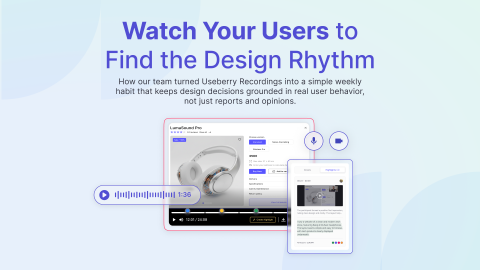



Every marketer knows the feeling of watching a campaign you loved fall flat. The visuals were strong, the copy was sharp, the budget was there but the response was lukewarm. The landing page didn’t convert as expected. The ad engagement looked good on paper, but the sales didn’t follow.
It’s not always about bad creative or poor targeting. Sometimes the message just didn’t land the way we thought it would. The good news is, we already have the tools to find out “why”. We just need to borrow a few habits from our UX peers.
At Useberry, our work with product and design teams revolves around understanding what people actually see, understand, and feel when they interact with something new. And that process is just as powerful when applied to marketing.
The Overlap Between Marketing and UX Research
Marketers and UX researchers are often after the same thing: understanding what drives people to act. The difference is mostly timing.
Marketing tests usually happen after launch, once the ad is live or the email has been sent. UX research happens before launch (and after of course), to validate assumptions while there’s still time to adjust.
By applying UX testing methods early, marketers can stress-test their ideas before spending a single cent on distribution. Instead of guessing how an audience might interpret a message, you can see how real people react to it in real time.
From Clicks to Clarity: Using UX Research to Strengthen Your Message
Every marketing decision is a hypothesis: “This message will resonate.” “This image will draw attention.” “This headline will convert.” But hypotheses need validation. That’s where user testing can make marketing smarter, not slower:
1. Five-Second Tests: Are You Saying What You Think You’re Saying?
Before you launch your next landing page, run a Five-Second Test. Show people your page for five seconds and then ask what they remember. You’ll quickly see if your value proposition stands out or if your copy gets lost in design. If users can’t describe what your offer is after a glance, chances are your campaign is trying to do too much.
The result? Sharper headlines, cleaner hierarchy, and higher clarity before the first click.
2. Preference Tests: Find the Message That Clicks
Marketers live in A/B testing mode, but most experiments happen after launch. A Preference Test brings that process forward. You can compare ad versions, banner layouts, or taglines and ask which one feels clearer or more trustworthy.
It’s not about which design people like better; it’s about which one communicates faster and feels more believable. These small pre-launch tests save money and help you walk into a campaign knowing what resonates.
3. Surveys: Add Context to the Numbers
We all rely on metrics like open rates, click-throughs, conversions but numbers only tell you what happened. A short Survey tells you why.
Ask questions like:
- “What did you think this ad was offering?”
- “What stood out most to you?”
- “What would make you click or sign up?”
You’ll learn whether people understood the message you intended or something completely different. And once you see that gap, you know where to refine your wording or visuals.
If you are curious about how testing supports marketing strategy beyond messaging, Leveraging User Testing to Optimize Content Marketing Performance shows how testing creative concepts and content pieces can directly improve engagement and ROI.
Seeing Reactions Before Results
The real advantage of bringing UX research into marketing isn’t just better performance, it’s faster learning. Before the first impression goes live, you can already see what people focus on, how they interpret visuals, and where confusion starts. You move from “launch and correct” to “know before launch.”
Even a small sample of reactions helps. Watching participants think out loud while reviewing your ad or landing page often exposes the one word, phrase, or design detail that changes everything. It’s also the kind of evidence that makes creative debates disappear because you’re no longer discussing opinions, you’re discussing behavior.
What Marketers Can Learn from Researchers
The best researchers aren’t just testing products; they’re testing assumptions. That mindset translates perfectly to marketing. Here are a few lessons worth borrowing:
- Start small. You don’t need a full research plan. One or two focused tests can uncover most of the friction points.
- Mix numbers and narratives. Performance metrics show patterns; qualitative feedback explains them.
- Share what you see. A 20-second highlight reel of people reacting to your message can convince a stakeholder to course-correct faster than a spreadsheet ever could.
- Keep iterating. Treat every campaign as a learning loop, not a verdict.
For an in-depth look on this overlap between research and marketing, see How UX and User Testing Reinforces Marketing Efforts. It expands on how testing practices help creative and marketing teams stay aligned around what users actually understand and respond to.
From Campaign to Conversation
At the end of the day, both UX research and marketing are about communication. One explores how people use products; the other explores how people connect with ideas. The more we learn from each other, the better our messages become.
UX researchers remind us that clarity isn’t something you assume. Before your next big campaign, consider adding one quick test from the user testing toolbox. It might save you from a headline no one reads or a message that doesn’t land.
Marketing that’s tested with real users feels better, because it’s built on understanding.
Don’t Guess What Your Audience Thinks
See early reactions to your copy and visuals so your campaigns land on the first try.