


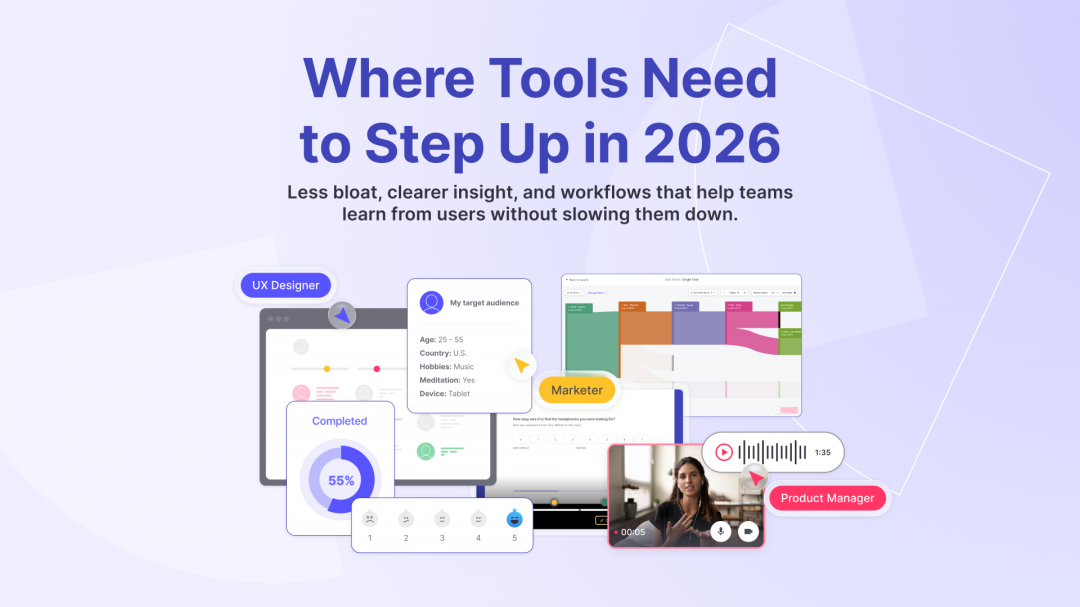
Every year, product teams add new tools to their stack. Research platforms, analytics products, design plugins, AI helpers. At some point, it starts to feel less like support and more like maintenance. Keeping everything connected becomes its own job.
In 2026, the real question for UX tools will be simple: how much easier do they make it to learn from users? New flashy features and functions matter less than the ability to run a study quickly, understand what happened, and share that understanding with others.
At Useberry, we see this shift in how teams use our platform. They are looking for fewer handoffs, fewer exports, and fewer steps between a research question and a clear answer. They would like to sign into the platform and have everything done in one place and avoid the tool bloat. Some of our most recent updates such as the recordings update was designed with this in mind, being able to all your videos into one hub and analyze together was a primary goal.
UX Tools Need to Reduce Noise
Most product teams already have dashboards, product analytics, and performance reports. What they still struggle with is linking those numbers to real user behavior. UX tools sit in the middle of that challenge. They are most useful when they make that link easier to see.
A practical tool in 2026 will help teams set up a study without a long checklist (with tools like Brand Kits and Templates), recruit participants from a reliable source, and review clicks, recordings, and study data in a single place. Instead of jumping between systems, people can stay inside one environment and follow the thread from task to outcome.
The goal is not just storing more information or offering more options. The goal is seeing the story behind that information, with less effort.
Usability Matters for the UX Tools as well
Teams have become more careful about bringing in new UX tools. A long feature matrix looks impressive during a demo, but it does not say much about how a normal week will feel with that tool in the stack. Sometimes it is not as easy to use as they make it seem either. Usability can’t be measured when an experienced user is demonstrating the use.
What people pay attention to now is the path from idea to insight. On Useberry, for example, a team can upload a prototype, choose a test type, recruit participants, and then watch real recordings from the same dashboard. They can turn key moments into highlights and share those clips with stakeholders without doing extra editing work somewhere else.
This kind of flow is what keeps research active instead of occasional. When it is simple to launch one more small study, teams do it. Over time, that habit prevents many of the surprises that appear when decisions are made without user input.
UX Tools Should Support Human Judgment, Even with AI Involved
AI has started to appear everywhere. It can summarize open ended feedback, propose themes, or suggest task questions. These abilities can genuinely save time, especially when teams are sorting through lots of sessions.
At the same time, researchers and designers still want to see the raw material behind any summary. Trust grows when a tool shows clearly how an AI output connects to real recordings, real tasks, and real answers. The responsibility for interpreting what those outputs mean stays with the people doing the work.
Useberry’s direction follows that logic. AI is there to speed up repetitive parts of the process and to surface interesting patterns, while observation and interpretation remain firmly in human hands.
How We Think About UX Tools at Useberry
For us, the future of UX tools comes down to three things: clarity, speed, and shareability. Clarity means that teams can see what users did and how they felt without digging through layers of disconnected reports. Speed means that a study can go from idea to live to initial results within a day, not weeks. Shareability means that findings travel easily between design, product, marketing, and leadership and in a form that they can easily digest.
That is why Useberry focuses on remote testing, flexible blocks for different methods, and features that makes life easier for our users and not just look nice on a presentation. Each part is there to make it easier to understand users and to show that understanding to others.
This year the UX tools that stand out will be the ones that quietly remove friction from this process. When a tool helps more people in a team ask better questions and learn from users, it earns its place. Everything else is optional.
See Where Useberry Fits in Your 2026 Research Workflow
Do you want UX tools that support real work rather than adding more noise?